ESCAPADE Deployed and en route to Mars

James
NASA's twin ESCAPADE spacecraft have successfully deployed from the Blue Origin New Glenn.
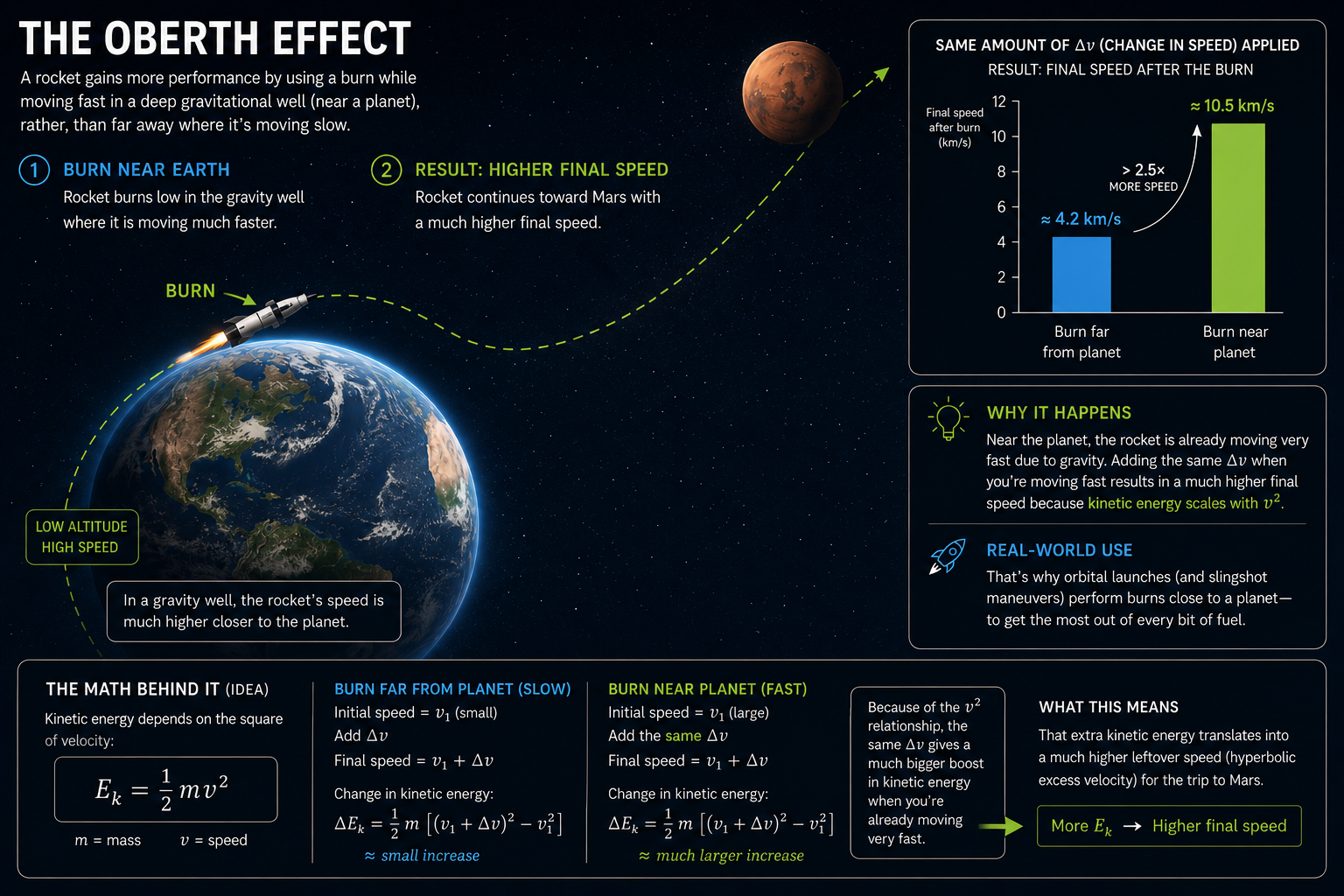
While technically en route, they will first be making use of the Oberth Effect. By entering a highly elliptical Earth orbit, the spacecraft relies on gravity to naturally accelerate to a tremendous speed as it falls back towards its closest approach (periapsis - or Perigee in this case). It is precisely at this point of maximum velocity that the trans-Mars injection engine burn is initiated.
The Oberth Effect describes how the kinetic energy of a mass varies in proportion to the square of its velocity; therefore, an increase in velocity imparts a significantly greater increase in kinetic energy when the spacecraft is already travelling at high speed compared to low speed, making the manoeuvre exponentially more efficient.
The primary goal of these relatively small and low-cost probes is to study the Martian magnetosphere and understand exactly how the solar wind continues to strip away the planet's thin atmosphere.
Because there are two identical spacecraft, they can take simultaneous measurements from different locations in the Martian orbit, providing a much clearer, 3D picture of the magnetic environment. It is a fantastic demonstration of how small-satellite technology can be leveraged for deep space planetary science.
[https://science.nasa.gov/blogs/escapade/2025/11/13/nasas-twin-escapade-spacecraft-have-deployed/](NASA’s Twin ESCAPADE Spacecraft Have Deployed)
Similar Posts



November 24, 2020
• 1 min read