
The James Webb Space Telescope has once again completely upended our understanding of the early universe. This month, researchers announced the discovery of a supermassive black hole that appears to have formed *before* its host galaxy.
NASA's Webb Reveals Black Hole That Formed Before Its Galaxy .
The classical model suggested that massive stars within early galaxies collapsed into black holes, which then slowly grew by merging and feeding over billions of years. However, Webb observed a "Little Red Dot" known as QSO1, existing just 700 million years after the Big Bang. By tracing the Keplerian motion of the gas swirling around it, astronomers directly measured the black hole at a staggering 50 million solar masses—making up at least two-thirds of the entire object's mass. It lacks a substantial host galaxy entirely, strongly suggesting it was born massive, perhaps directly from the collapse of a primordial gas cloud. A total paradigm shift!
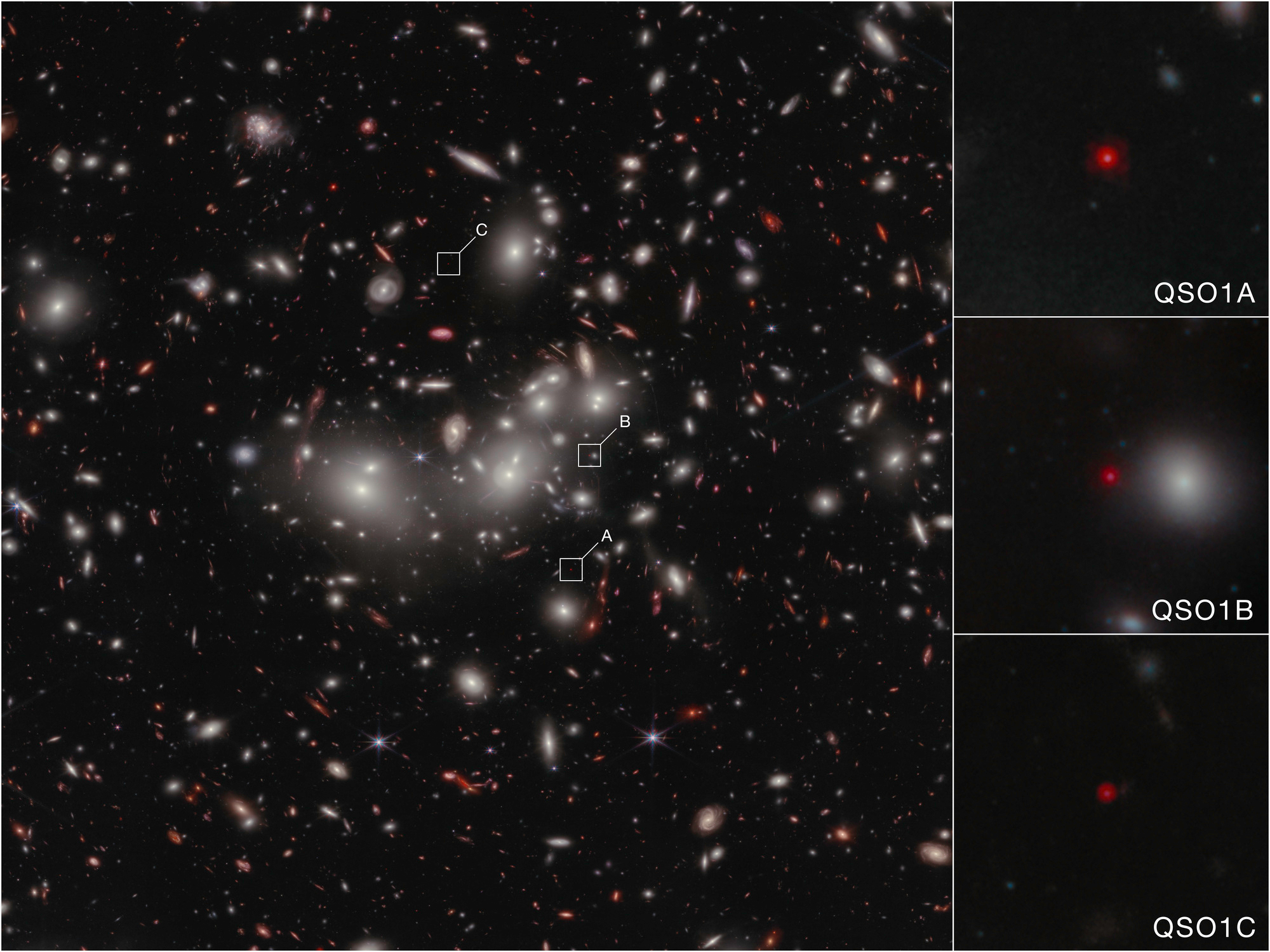
"An image from NIRCam (the Near Infrared Camera) on NASA’s James Webb Space Telescope shows Abell2744-QSO1, magnified and triply imaged by galaxy cluster Abell 2744."
Credit Image: NASA, ESA, CSA, Lukas Furtak (Ben-Gurion University)
Image Processing: Alyssa Pagan (STScI)
Similar Posts


