
SETI's mission is to explore, understand, and explain the origin and nature of life in the universe, and to apply the knowledge gained to inspire and guide present and future generations.
"We have a passion for discovery, and for sharing knowledge as scientific ambassadors to the public, the press, and the government."
The SETI institute is a private, non-profit organisation dedicated to scientific research, education and public outreach that began operations on February 1, 1985; today it employs over 130 scientists, educators and support staff.
The search for extraterrestrial intelligence is an exploratory science that seeks evidence of life in the universe by looking for some signature of its technology. Our current understanding of life's origin on Earth suggests that given a suitable environment and sufficient time, life will develop on other planets. Whether evolution will give rise to intelligent, technological civilisations is open to speculation, but SETI are looking - because you just never know!
Data collected by SETI's radio telescopes is extensively processed (to look for signals in the noise) by the public by using seti@home ("SETI at home"), an internet-based public volunteer computing project. Once a volunteer is signed up, the automated software system sends data to the PC in question and it then uses the PC's processor (when it is not in use by the everyday user) to do the processing. In this way citizen scientists can help in the search for ET!
My own contribution just passed one million cobblestones of computation. The "Cobblestone" is named after Jeff Cobb of seti@home. By definition, 200 cobblestones are awarded for one day of work on a computer that can meet either one of two known benchmarks.
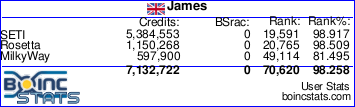
Editorial Note: When this article was originally published, these statistics were displayed via a live widget showing just over one million cobblestones. SETI@home continued running for several years until the project officially entered hibernation on March 31, 2020. The image above is a static snapshot captured after the project's closure, which explains why the final tally is significantly higher than the original one million.
In fact...
Credits (Cobblestones): This is the total amount of computational work completed - which now stands at 5,384,553.
Rank%: This is arguably the most impressive statistic on the board. For SETI, a rank percentage of 98.917% means that when SETI@home ended I was in the top 1.1% of all participants worldwide.