
Astrophysicists have achieved something monumental this week.
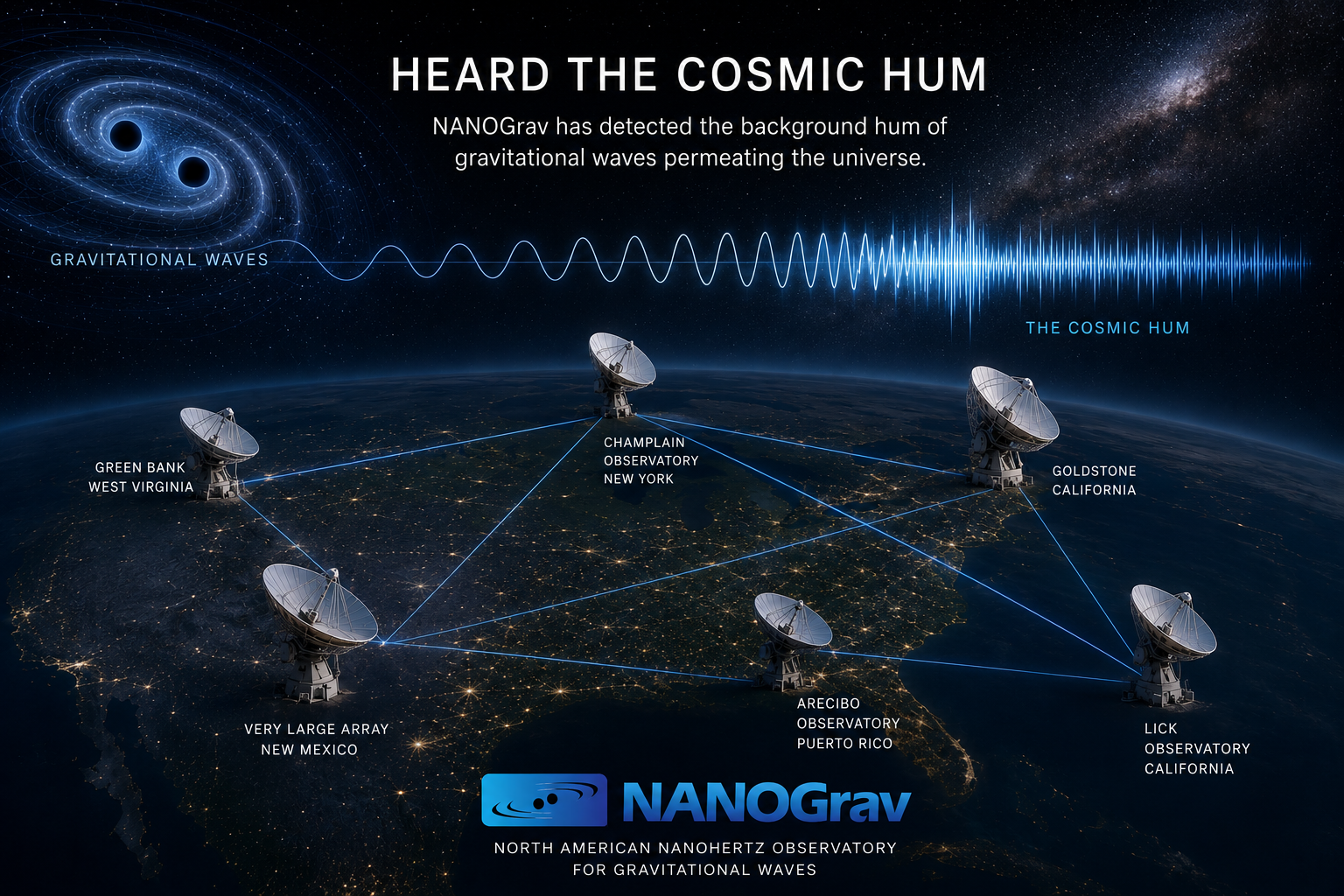
Using a continent-sized network of radio telescopes known as the North American Nanohertz Observatory for Gravitational Waves (NANOGrav), scientists have "heard" the background hum of the universe.
By meticulously timing the incredibly precise flashes of pulsars across the galaxy, they detected subtle, synchronised variations caused by low-frequency gravitational waves washing over our solar system. These slow, immense ripples in spacetime are the chorus of thousands of supermassive black holes slowly spiralling towards collision across the cosmos. It is a completely new way of observing the universe, moving beyond light to physically feeling the fabric of space vibrate.
As reported; "We report multiple lines of evidence for a stochastic1 signal that is correlated among 67 pulsars from the 15 yr pulsar timing data set collected by the North American Nanohertz Observatory for Gravitational Waves." or to put it another way - a faint, random rumble in space, and it's shaking all of our cosmic clocks in a coordinated pattern.
- Random or unpredictable over time.
https://iopscience.iop.org/article/10.3847/2041-8213/acdac6
Similar Posts


August 30, 2019
• 1 min read